Warning, today’s post is a bit more wonkish than normal; enter at your own risk! Kevin Warsh gave his first coming out speech at Jackson Hole Wyoming on Friday, and gave what appeared to be a more hawkish view of future monetary policy, admitting that monetary policy might have “more work to do” if inflation doesn’t go down. His comments caused a sharp and short downward move in the 10-year rate (only about 4 basis points) but almost as quickly as it went down it began moving higher into the close of the day. Gold was whacked pretty good (after a month of increasing by over 10%) as higher short term rates make the opportunity cost of holding gold, which has no yield, higher. We reviewed implications of this earlier this year; the dollar debasement trade still seems to be a thing. But will Kevin Warsh stop that speeding train with higher rates?
Mr. Warsh is in a real pickle. By many measures of monetary liquidity (e.g., credit spreads, credit default swaps), conditions are relatively loose. And yet one of the key measures for political reasons is the cost of a mortgage and therefore a home, and there conditions appear tight. Mr. Trump has been pounding on the Fed for lower rates, and Secretary Bessent last week made an effort to try and take the long-term rate down by replacing off-the-run 30 year bonds with shorter term issues. And yet long term rates steadily move higher, as more than a $2T deficit as well as the private sector rush by hyper-scalers to build out AI infrastructure are sucking every available dollar away from things like housing. We will have to watch what Mr. Warsh actually does (not what he says) but he is saying some important things. One of the most important was his call that money matters. This was recognized as a truism for decades following Milton Friedman’s seminal work in 1963 (with Anna Schwartz), but this wisdom has been forgotten. And Mr. Friedman was wrong in his belief that there was always going to be a precise relationship between money and inflation (after all, his work had shown that tight relationship for 100 years prior, both in the U.S. and internationally), as monetary innovation and changes in technology (e.g., ATMs, ability to move money electronically with ACH, MMMF’s, etc) changed the demand for money in the economy. But the Fed went to the other foolish extreme–from only money matters to money doesn’t matter at all! Thus the Fed has fixated on interest rates, and ignored the money supply, which has been a great mistake (more below). I found Mr. Warsh’s comments encouraging in this area:
Money matters. It’s not fashionable these days, but my view is that money has something important to do with monetary policy. We should pay attention to money created by the central bank and money that comes from the banking and financial systems. It’s true that financial innovations and other factors alter the mechanics that link the monetary base, the velocity of money, and the broader economy. But that is scarcely a reason to ignore the ultimate effects of money on financial conditions and prices.”
This is why I wanted to see Mr. Warsh selected as the Fed chair. He alone is not sufficient to effect the institutional change needed, but perhaps he can slowly turn the ship. And the biggest area of mischief is the outrageous growth in its balance sheet (the Federal Reserve’s buying of assets, mostly treasuries at this point) which puts its thumb on the scales of the economy significantly. Mr. Warsh has one of his task forces looking at the size of the balance sheet, although he has previously said he’d like to bring it down. However, in their “ample reserves” regime, the Fed has been buying more assets and expanding their balance since 12 Dec 2025. Mr. Trump’s pressure on Jerome Powell did not lead to lower interest rates, but easy money came nonetheless, as you can see in the modest but clear uptick in the M1/M2 broader money supply figures. Ostensibly the purchase of assets was simply to provide the needed market liquidity for reserves that would allow the banking system to function normally, but as you can clearly see, it opened up the spigots, with money supply growth now ~100% higher than prior to the change. This monetization of the our public debt is a good part of why inflation has not returned to the Fed’s stated 2% target, and it has been well above that for over 5 years.
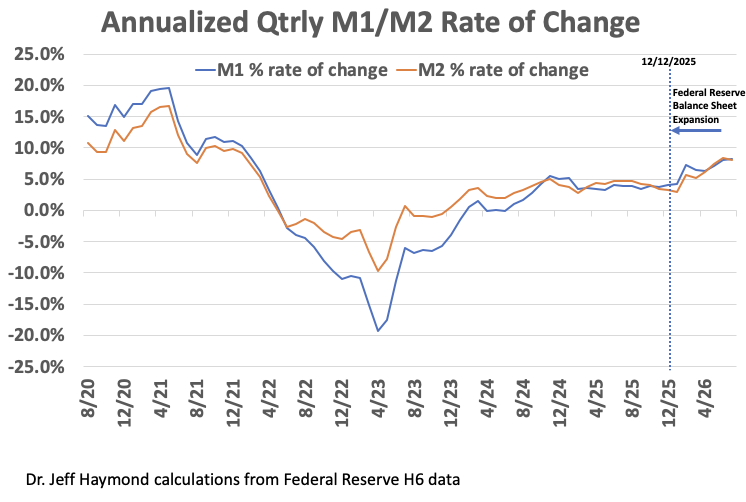
At the end of the day, central banks are the buyers of last resort for the sovereign’s debts. And with the US at $2T deficits and $40T of debt (which the publicly tradeable portion of debt’s average maturity is a little over 2 years), the bond market is having to fund about $18T of public debt each year. That, coupled with the expansive AI buildout, means that interest rates are likely to continue slowly rising. Should the U.S. Treasury be successful in capping long term yields (or get the Fed to join the yield capping party), that will just mean the escape valve will be in the dollar losing value (which is exactly what Japan has seen as a result of its yield capping strategy because of its massive debt). Either way, at the end of the day, this is going to be inflationary if we keep spending well above our means. It will either have to be directly monetized by the Fed, or it will be reflected in the value of our dollar falling, making imported goods much more expensive (which sadly is the goal of some in the administration*).
We are warned in scripture about the dangers of debt. But as a nation, we keep wanting more of it, since we like government spending as long as someone else is paying it. But eventually, that someone else is all of us via inflation and dollar debasement. I see no change in the horizon.
* If I hadn’t seen the clip I wouldn’t believe it, but J.D. Vance is against the U.S. being the world’s reserve currency, which has effectively allowed the U.S. to tax the rest of the world since WWII ended. This is not wise policy. I may have time to discuss this in the future, but not today unless you want in the comments.
 Bert Wheeler
 Jeff Haymond
 Marc Clauson
 Mark Caleb Smith
 Tom Mach