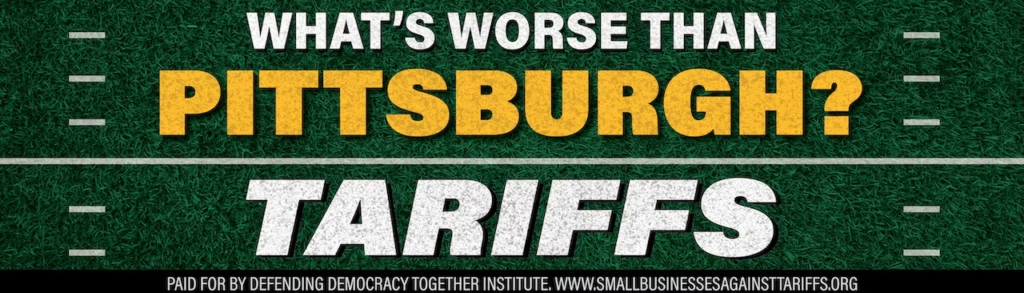
Even though I’m a lifelong Pittsburgh Steelers fan, I still had to smile yesterday while driving through Cincinnati as I saw this billboard this weekend. The group Small Businesses Against Tariffs unveiled a million dollar ad campaign last week across seven states to remind football fans how tariffs are hurting them. And hurting them tariff’s are:
Ohio’s trading relationship with Canada makes the state a significant audience for that message, she said. Canada bought $18.3 billion in Ohio goods in 2025, accounting for nearly one-third of the state’s exports — more than its next four largest foreign markets combined.
Atassi acknowledged Trump’s stated rationale: countering Canadian trade practices he considers discriminatory and protecting American producers. But she argued that the consequences for Ohio undermined that defense. “The consequences are landing on our manufacturers and our farmers and our small businesses and ultimately on the customers,” she said. Quinn described trade between the neighbors as a source of mutual prosperity and argued that interrupting it hurt Ohioans who would soon be casting ballots. “I can’t see how anyone can defend the philosophy behind these tariffs at this point,” Atassi said.
Mr. Trump was open about his plans to go whole-hog on tariffs, but I don’t think many Americans thought he’d do much in that area. But they were pretty sure he’d do something about the border. And they remembered that pre-Covid the economy was pretty good, and prices were much lower. Yet here we are, and Mr. Trump has made tariffs the centerpiece of his 2nd administration–not just a side hustle hobby as in his first term. These tariffs are not just disliked by free market economists; they’ve been broadly unpopular since day one of his initiation of them. His “Liberation Day” tariffs almost broke the stock market, and he had to subsequently pull those back (the stock market was getting “a little chirpy” Trump said).
The CATO Institute (a free market libertarian group) commissioned a poll on tariffs a couple of months ago that is illuminating. The poll included over 4000 participants, which if properly done should be very representative of public opinion (and indeed it’s consistent with other polls over the last two years).
74% Say President Trump’s Tariffs Have Raised Prices; 53% Say Tariffs Have Weakened the Economy, 70% Say the President Needs Congressional Approval to Impose Tariffs
A new Cato Institute/Morning Consult survey of 4,150 registered voters finds that three in four (75%) say tariffs will be important to their vote in this November’s midterm elections.
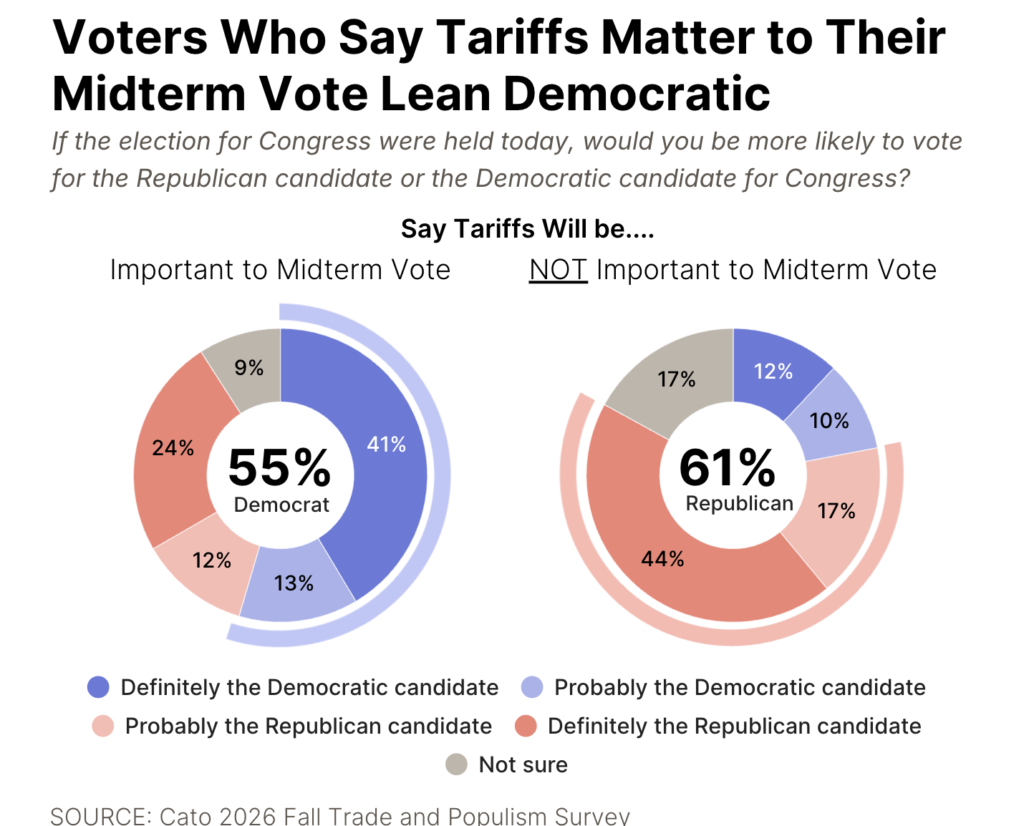
Nearly the same share—74%—say that Trump’s tariffs increased the prices of things they buy at the store, including 66% of Republicans and 84% of Democrats. Majorities say the tariffs are a tax on Americans (57%) and believe they have weakened the US economy (53%), while just 23% say the tariffs have improved their personal quality of life. Overall, 57% have an unfavorable opinion of President Trump’s handling of trade policy (an increase from 54% in March), while 43% have a favorable view. Together, these findings suggest tariffs could pose a political liability for Republicans in the midterms, particularly among independents and voters concerned about higher prices. The survey finds that a plurality of Americans plan to vote for the Democratic candidate for Congress over the Republican candidate by 47% to 42%, with 11% unsure.
Note that this is not a partisan issue, although Republicans were more accepting of the tariffs than other groups:
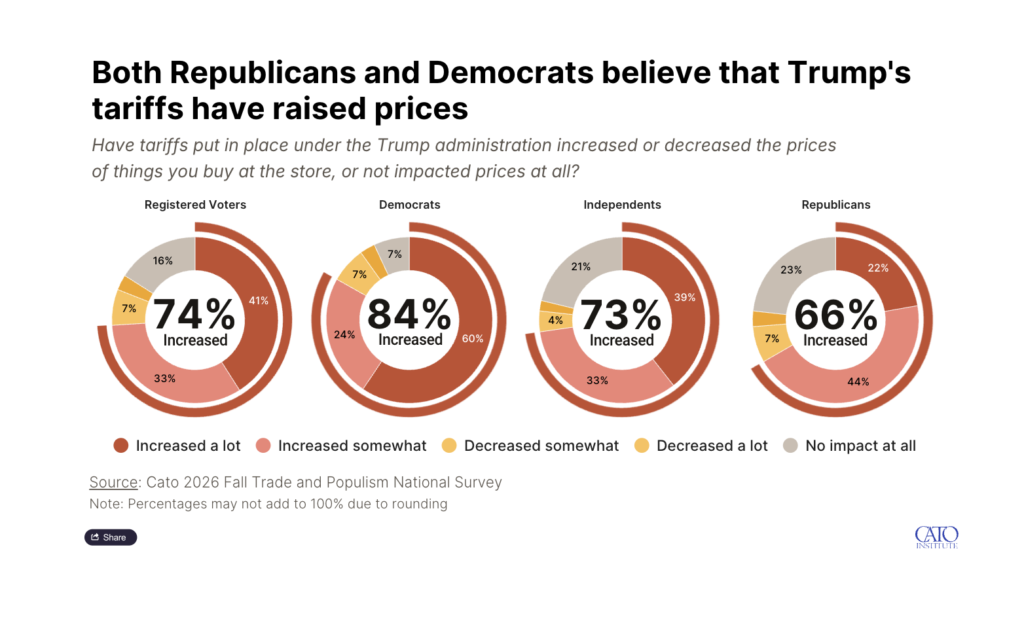
This is a self-inflicted wound and Republicans may pay the price. They are unable to stand up to the singular proponent of this (Mr. Trump), as they are caught in the vise between MAGA populists and the rest of the population. They understand the harms of the tariffs, but can’t do anything about them*, so speaking out against Mr. Trump is a no-win situation. Nevertheless the Democrats have shot themselves in the foot with their candidates this fall, and the CATO poll may be capturing some of this. Note the much larger # of Democratic voters that were definitely going to vote Republican in the fall as compared to the Democrats. 24% of Democrats are definitely voting Republican as compared to 12% of Republicans. While these may be core Democratic voters who vote populist with Mr. Trump, those usually have reverted back to the Democrats in the off-years (or stayed home). Not definitive for sure, but interesting.
* Mr. Trump has acted via executive orders, which have been determined by the courts to be unconstitutional, and we’re now applying Smoot-Hawley {yes those tariffs!} as his tool until they likewise are rejected by the courts which is likely (although the damage to the economy will already be done).
 Bert Wheeler
 Jeff Haymond
 Marc Clauson
 Mark Caleb Smith
 Tom Mach