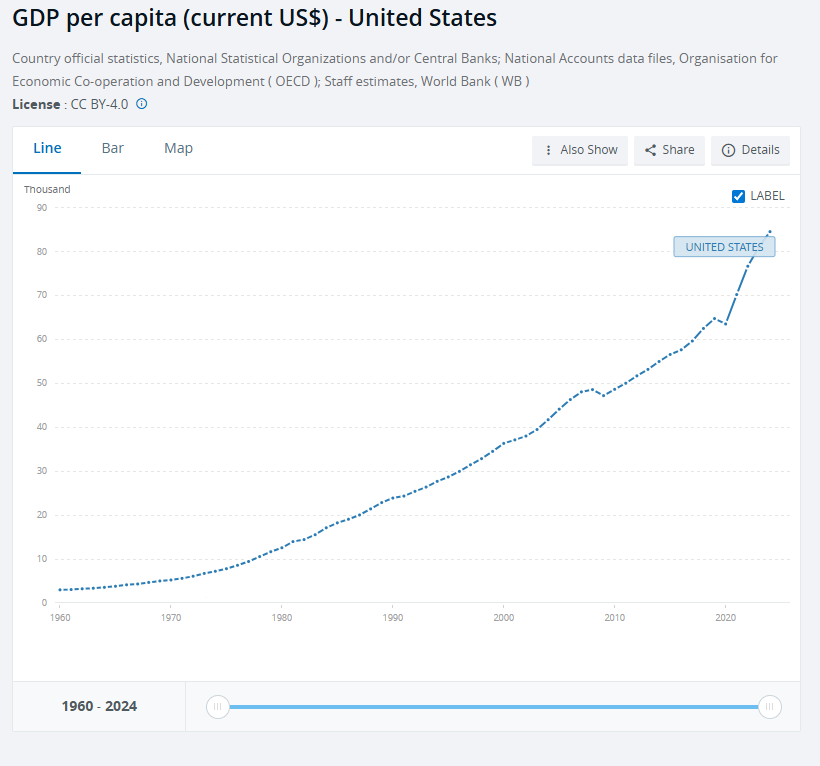
Economic theory argues that the only way to increase wage growth is to embrace productivity growth, which is largely driven by capital investment (both human and physical capital). You don’t need an economics Ph.D. to notice that virtually every vocation has embraced technology as a means to drive efficiency, and that very productive efficiency is what leads to higher wages. Yes it transforms our economy, but it frees up resources that can more productively be applied elsewhere. In general, every major technological revolution has led to higher employment and higher wages, albeit not necessarily in every given industry (e.g., there are a lot less people involved in farming today than a hundred years ago). Yet sometimes technology innovation leads to increases in employment in that area (e.g., introduction of mechanization in England in the 18th century for textiles manufacturing) as well as wages. U.S. per capital income continues to increase, primarily driven by technological improvements:
Yet the conclusive lessons of history are rejected by the modern luddites with respect to AI. Claims that AI will replace many jobs are commonplace, even sometimes amongst AI supporters. Is this time really different? I don’t think so. As I (and most of my faculty) commonly tell our students, AI isn’t going to replace you, but someone that has AI in their toolkit will replace you. But in some areas that data are already in, as Torsten Slok notes in a chart of the “Radiologist paradox”:
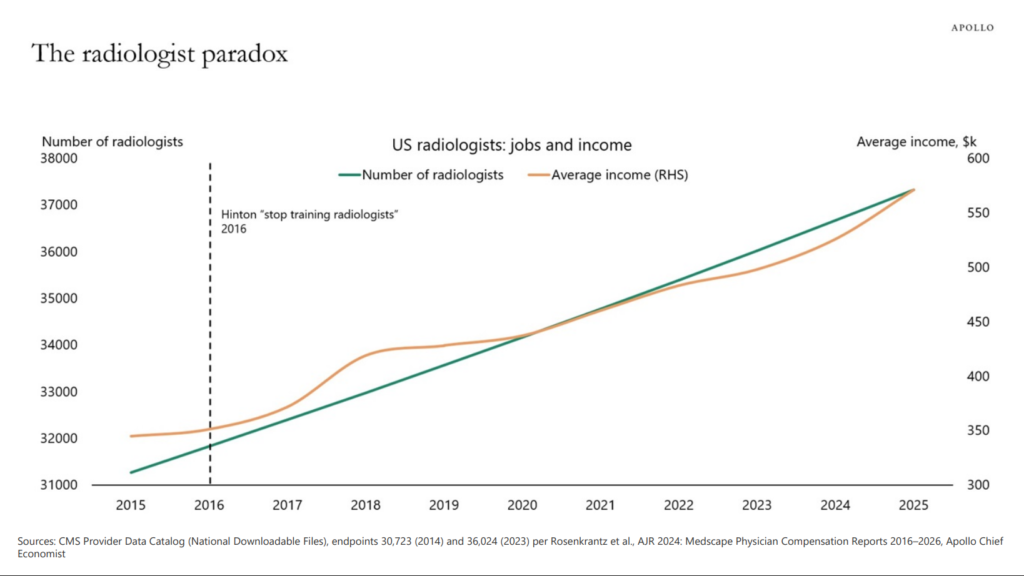
Nobel Laureate Geoff Hinton suggested in 2016 that we should stop training radiologists since AI could do it better. Yet the data show radiologist employment and wages have risen (with average wages greater than $550k/year!). Hinton was of course correct in that AI would enable much better scanning, but he failed to initially note that radiologists would use this as a tool to increase their efficiency and their accuracy. Lower prices from efficiency lead to increased demand for that good or service, ultimately demanding more of all the productive inputs, including labor. Shock, who woulda thunk it?
 Bert Wheeler
 Jeff Haymond
 Marc Clauson
 Mark Caleb Smith
 Tom Mach