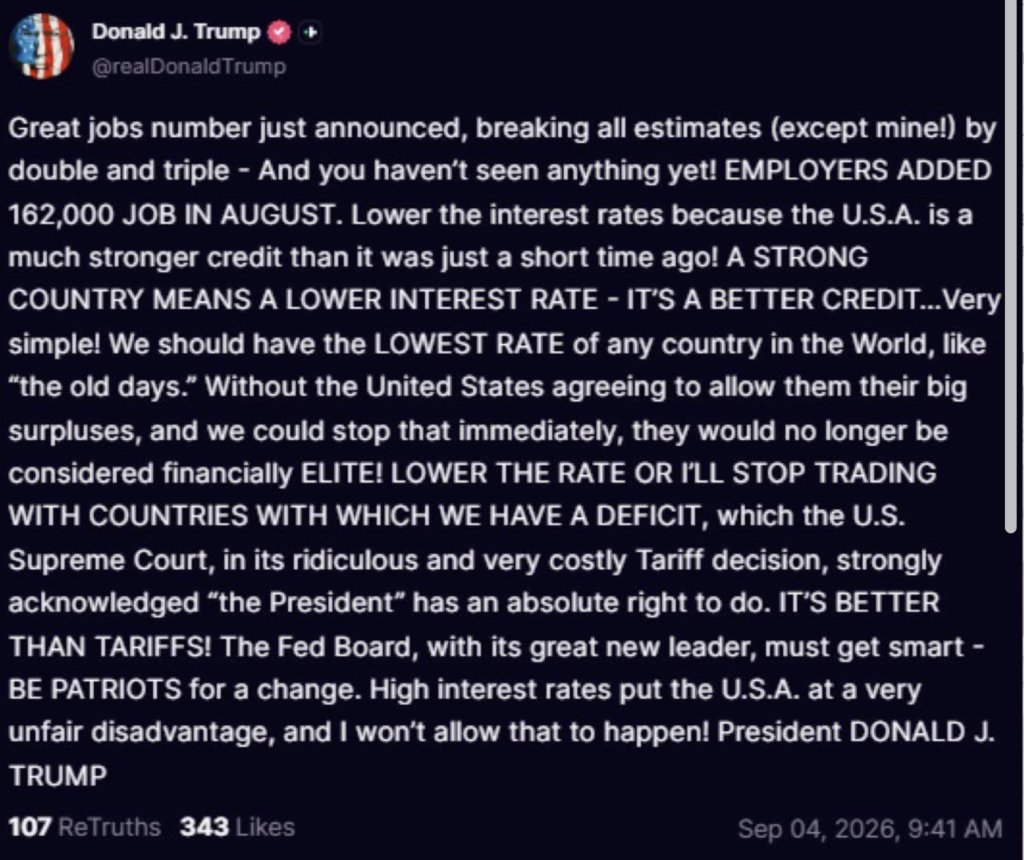
I don’t normally like to pay attention to Mr. Trump’s Truth Social posts, as the point usually seems to be to inflame the passions of those that he is tweaking. Certainly the only ones I see (since I’m not on that platform, and certainly not paying the big bucks to get instant access!) are that way, as I see reactions in other online sources. Yet Mr. Trump followed this missive in his comments to the press Friday of a similar nature:
White House reporter (Friday, September 4): “… A rate hike could reassure the bond market…” President Trump: “To me, it doesn’t reassure the bond market. To me, you do a rate cut, because we should be at one percent or a half a percent. We should not be at 4%. As I’ve explained, we could do tremendous good for ourselves by just not trading with countries. We lose with the European Union $200 billion a year. If I didn’t trade with them, we’d lose nothing. Just one swipe of the pen. We lose with Mexico $195 billion a year. If I don’t trade with Mexico – they have nothing that we have to have. I mean, hot tamales, tomatoes, a couple of things. But basically, they have nothing that we need. We have oil, we have everything. I don’t want to do that because we get along very well with the president – we like the president and respect her a lot… If we didn’t want to trade with Canada – we would save from $60 to $90 billion a year, by just not trading with Canada. Now Canada would be in a heap of trouble. I don’t think they would exist. Because, again, they do 95% of their business with us. So, if I say we’re not going to trade, that means 95% if their business gets wiped out. I don’t know what they would do. So, we should have the lowest interest rate, as we used to 25 or 30 years ago when we were smart.”
F.A. Hayek wrote his book The Fatal Conceit as an extension of his talk condemning socialist thinking in his acceptance speech for his Nobel prize in economics in 1974. Hayek’s work highlighted the “knowledge problem” that confronted socialism, which argued that the economic system that would be best would use the totality of knowledge in an economy. He noted that elite knowledge was only a part of the story, and that everyone, including “the man on the street,” has knowledge of needs that are out there and possible solutions. The socialists glibly argued they would use whatever production methods were the best technique, not failing to see that the best technique is only daily discovered through the market process of millions of individuals bringing their knowledge to the economy. One man, however brilliant, is woefully inadequate to the challenge. And one central committee, or one presidential administration, also suffers from this limitation. To argue otherwise is to engage in The Fatal Conceit.
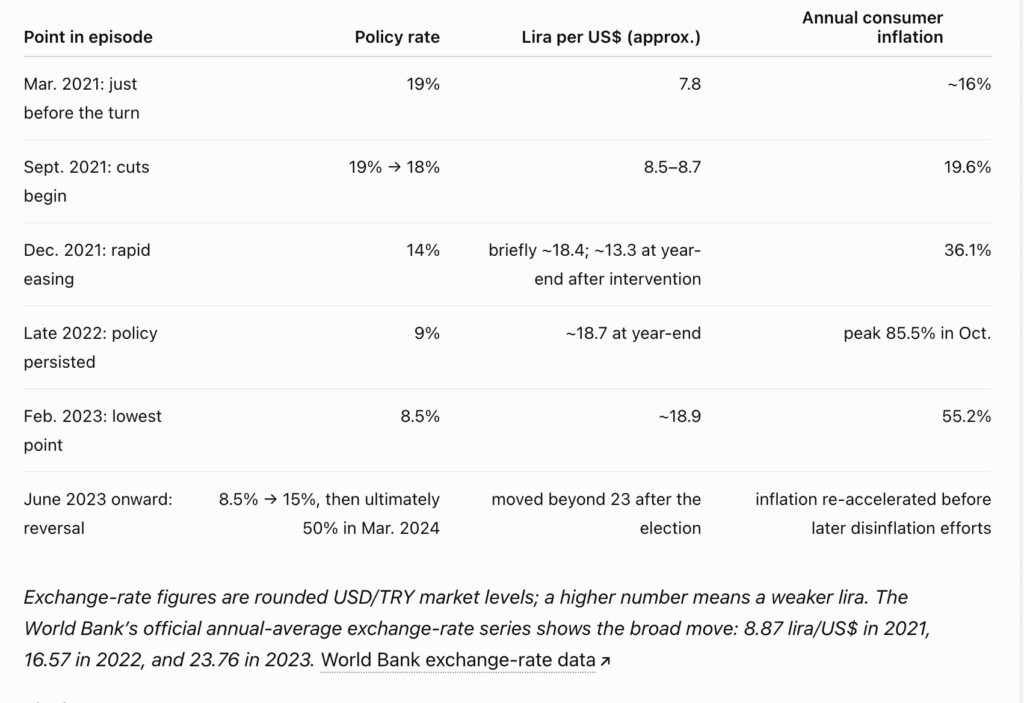
Powerful politicians are especially likely to succumb to the siren song of the Fatal Conceit as almost always they can manipulate the economy in the short run to achieve certain political objectives and the consequences are usually delayed months to years. Argentina’s Christina Kirchner famously tried to put economists in jail for reporting on inflation after she and her husband changed official inflation calculations that would reveal their monetary mischief. She was able to goose the economy in the short term to win re-election, but the ensuing inflation that followed punished Argentinians severely. More on point with Mr. Trump’s statement, President Erdogan of Turkey more recently (2021) started to address inflation by lowering interest rates! Does this sound familiar? Here is a table of the results (from ChatGpt) that summarize the results. Note the cuts led to a rapid deterioration in the Lira, and resulted in a massive spike upwards in inflation. Now I’m not arguing that our economy is like Turkey’s, but the direction truly only goes one way.
In our last two posts, we’ve highlighted the relationship to our monetary growth, inflation, and the value of the dollar. Mr. Trump’s comments are ignoring the very big gorilla in the room, and one which he could tackle but refuses to: our national debt and deficit are putting pressure on interest rates. None of us know where the doom loop tipping point will be, but the last year has seen a steady fall in bond prices leading to higher yields, and there is nothing in the fundamentals to stop that decline. Indeed, the easy money policy that Mr. Trump is arguing for (and which pretty much politicians everywhere argue for) has already started with the Fed’s expansion of its balance sheet, which is putting monetary juice into our inflation brew. Were the Fed to actually lower interest rates at the next meeting, you would likely see a rapid appreciation in long term bond yields, as markets would know the already almost certain approach to deal with the debt–inflation–is soon to commence.
Mr. Trump’s comments about tariffs are pure noise and just to further muddy the waters to blunt criticism of his tariffs. He will never admit publicly that he was wrong, although this past week’s decision to drop tariffs on Argentinian beef are an explicit acknowledgment that tariffs increase prices to the American consumer. There is zero relationship between trade deficits (which to remind you are always matched by a capital account surplus when we have flexible exchange rates {we’re no longer on a gold standard}) and budget deficits, although that may not be what he was arguing for. If he simply is asserting that trade $$ going to another country are $$ not spent (so we save), he is not recognizing that for those doing the spending, they will have to spend more on U.S. alternatives or pay the higher tax of the tariff. So it doesn’t save us anything. Of course that will be what the administration wants–we shouldn’t be able to buy cheaper goods/services overseas, because that doesn’t support Americans. The obvious fallacy in that thinking is that when we import from Canada or Mexico, those dollars come back and buy other goods and services in other parts of our economy, where we have a comparative advantage. One of the big lies (and yes it is a lie unless they are very ignorant, which I don’t believe they are) is that tariffs protect jobs. In reality tariffs simply rearrange the jobs from areas where we are more competitive to areas where we are less competitive (but more politically connected, e.g., union-dominated manufacturing jobs). While there may be debatable and short term benefit to those in the protected industries, the general public is always left poorer. But for the politician, that is a feature not a bug.
My admonition to Mr. Trump: Supply and Demand in the long run remain undefeated. Your denial of this is a Fatal Conceit, and will Make America Poorer Again.
 Bert Wheeler
 Jeff Haymond
 Marc Clauson
 Mark Caleb Smith
 Tom Mach