Yes, I sometimes like alliteration. We’ve been chronicling the trials that Mr. Trump’s tariffs have caused the broader economy, and I have regularly warned about the political ramifications of Mr. Trump not meeting the real political market demand of reducing prices. In today’s post I want to highlight two issues. The first is Mr. Trump’s announcement of a $12B bailout of U.S. farmers. To be sure, the travails of the tillers are not exclusively due to tariffs, but tariffs are nonetheless a big part of the story–especially for soybeans. As we have repeatedly reminded readers, trade restrictions only help one American by harming another. Those “protected” from imports harm our strong export companies. In this case it is exacerbated by China deliberately trying to harm red states that voted for Mr. Trump. And let’s face it–we lost in this trade conflict with China. We relented on most things and got very little–except a promise that they would curtail fentanyl precursors (a promise they made in his first term, which they did not keep). Tillers, aka farmers, were hurt in both directions, as Mr. Trump’s tariffs have increased input prices while lowering their export prices. Farm bankruptcies are up, and already China is buying far less soybeans than his agreement with them suggested (and that is much less than they did formerly pre-tariffs).
In a trade war, which despite what Mr. Trump says are not “easy to win”, China has a structural advantage against the United States. They have a dictator, who has planned for years on how to resist foreign pressure, and they have been crafting alternative supplies for quite some time. And on the export side, China has been able to redirect exports to other countries, and are using export growth to offset their internal economic miseries (primarily the collapse of their real estate bubble which burst a couple of years ago but has ongoing effects). Consider this chart, which is causing great angst to other countries on the receiving end of China’s exports:
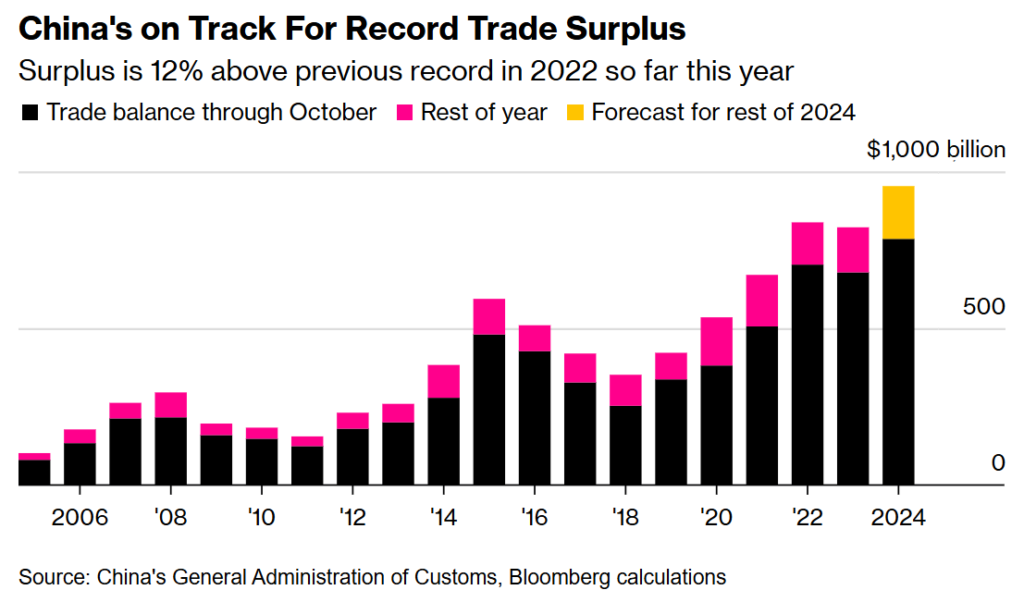
The U.S. tariffs have clearly not slowed China’s economy down. And in contrast with Xi Jinping, Mr. Trump has only a few years to operate and he has deliberately alienated the opposition party, making a consensus national commitment to oppose China economically more difficult. Hence, in our competition with China on trade, we lose.
This is exacerbated by Mr. Trump’s insistence that he have trade wars against the entire world. There are legitimate trade issues with China due to national security concerns, in addition to their continual theft of U.S. intellectual property. This is where alliances come to play–alliances that Mr. Trump has cavalierly set aside. If Mr. Trump could have martialed the world to collectively confront China, they would have to crumble, as their internal economy is in bad shape and the massive move toward even more exports is the only thing keeping them afloat. Further, Mr. Trump’s tariffs on the rest of the world (e.g., Vietnam) has reduced the incentive to further decouple from China, as the next low cost producers have also had their costs rise. In addition, the rest of the world is not happy with China, as China has been using its economic power to belligerently threaten other countries in isolation for years, as they are currently doing with Japan in response to Japanese Prime Minister Sanae Takaichi’s comments about standing with Taiwan. Alliances with other countries, even ones that we really have important differences with, really do matter. However much Canadian Prime Minister Carney is hostile to our values, we don’t want to make our neighbors embrace China over us, and that is exactly what is happening now.
 Bert Wheeler
 Jeff Haymond
 Marc Clauson
 Mark Caleb Smith
 Tom Mach