When Joe Biden tried his patently illegal scheme to transfer billions of dollars of debt from student loan takers to a favored constituency, the only question was would someone have legal standing to get the case before the courts. There was little doubt that once there, it would be squashed, and it was in Biden v Nebraska, 6-3. Biden had campaigned on that–surely the courts should bow down to the will of the people! But Congress refused to give him that power–the power of the purse being the constitutional prerogative of the legislative branch. Mr. Biden’s attempted power grab was particularly noxious as it was a pure theft of the treasury. He did have legal power to amend terms of loans and in other more limited ways, curtailing the collection of debt which he did (saddling the U.S. Taxpayer with the debt that others incurred). But the white whale he grasped for was beyond his aged fingers reach.
Yesterday the U.S. Court of Appeals for the Federal Circuit upheld “a decision of the Court of International Trade setting aside five Executive Orders that imposed tariffs of unlimited duration on nearly all goods from nearly every country in the world, holding that the tariffs were not authorized by the International Emergency Economic Powers Act (IEEPA), 50 U.S.C. § 1701 et seq.” Mr. Trump, like Mr. Biden before him, does have ability to impose tariffs on other countries, for many reasons, which Congress has delegated to him. Indeed, Mr. Trump used many of those authorities in his first term, stretching the definition of a national security threat well beyond what most would agree to (e.g., Canadian steel and timber was a threat to the U.S.). Nevertheless he could do that, as these were limited to specific situations. He could have appealed to these delegations in his 2nd term (and may yet try to fall back to them) but he wanted to make tariffs taxes on U.S. citizens’ and firms purchases of imported goods the centerpiece of his economic and foreign policy framework. He wanted to use a power that was, constitutionally, forbidden fruit to him. And yesterday he was reminded that we live in a constitutional republic, with separation of powers. While the powers of the presidency are indeed immense, they are circumscribed. In yesterday’s decision, the key issue was the “unlimited” nature of Mr. Trump’s assertion of his ability to use tariffs, both in the scope and duration of his actions. This audacious claim was suspect from the beginning, since the constitution explicitly gives congress the power to tax (to include levying of tariffs), and any delegation must be limited. Congress cannot, even if it should desire, delegate it’s powers completely to the executive department. As the court yesterday wrote,
Notably, every Congressional delegation to the President of the core legislative power to impose tariffs includes well-defined procedural and substantive limitations. For example, Section 232 of the Trade Expansion Act of 1962 authorizes the President to adjust the importation of certain articles if the Secretary of Commerce finds that they pose a threat to national security. 19 U.S.C. § 1862(c)(1)(A). The statute provides the President must, within ninety days, determine whether he concurs with the Secretary’s report, and if he does concur, “determine the nature and duration of the action that . . . must be taken . . . so that such imports will not threaten to impair the national security.” Id. § 1862(c)(1)(A)(ii). The President must take any such action within fifteen days of his determination. Id. § 1862(c)(1)(B). In all instances, section 232 requires the President to “submit to the Congress a written statement of the reasons why the President has decided to take action, or refused to take action.” Id. § 1862(c)(2).
The court further noted that Mr. Trump’s preferred tool this term for his tariffs, the International Emergency Economic Powers Act (IEEPA), does not even mention the word tariff! Conservatives praised the courts for restricting the overreach of Mr. Biden, and should today do so as well in the case of Mr. Trump. At BATG I have repeatedly warned that we should oppose the Imperial Presidency, whether we agree with the policies or not. Our constitutional republic is IMHO, the best protection for the people in a fallen world. As Lord Acton reminds us, “power corrupts and absolute power corrupts absolutely.” We must always ask the economist’s favorite question, “and then what?” If this power is granted to Mr. Trump, how will that be applied by President AOC or President Sanders? Or President Mamdami? Rabbit trail–this is exactly why we don’t want to have the Trump administration taking capital stakes with Intel or any other company (and Mr. Trump says he wants to do these deals all day long). Imagine what will happen with the next progressive politician–they’ll take that and raise you by 100. Ok, back on track. Unfortunately, the decision leaves the tariffs in place until mid-October to allow the administration to appeal. I confidently predict that the Supreme Court will reach a similar verdict. Mr. Trump continues to defend them, in a campaign that will Make America Weak Again.
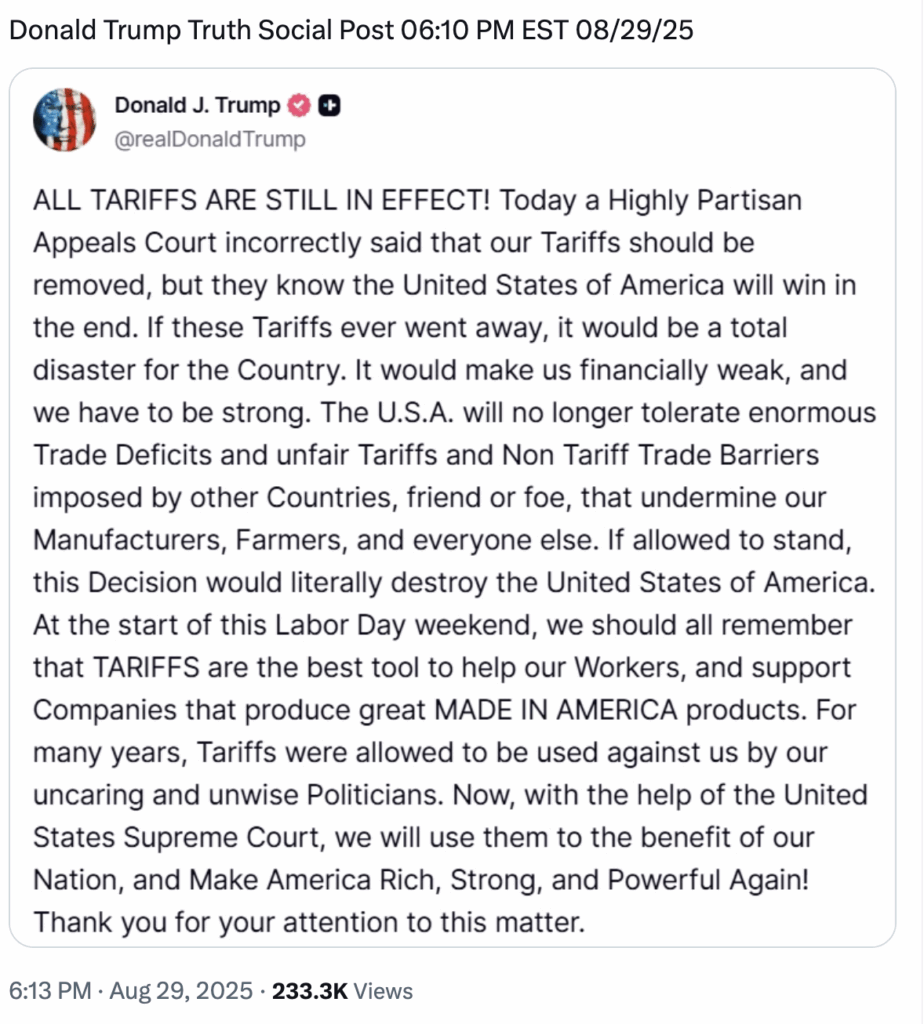
Just to close with yet another anecdote from the WSJ on the difficulties of navigating Mr. Trump’s daily-changing tariff policy:
How much should a copper bathtub cost? Clifford Thompson is trying to figure that out. Until now, the hand-hammered tubs his family-owned business imports from India have carried a suggested retail price of about $3,300. President Trump’s 50% tariff on copper imports and steep levies on goods from India are forcing Thompson Traders to rethink that price, but settling on a new one isn’t easy.
Just this week, the levies on Indian goods doubled to 50%—days before an appeals court late Friday struck down the legal basis for at least part of those tariffs, a ruling likely heading for Supreme Court review. The North Carolina company’s negotiations with big-box retailers over even small price increases are maddeningly slow. And Thompson, the company’s president, isn’t certain what inflation-weary consumers will accept—or how much competitors plan to charge.
“Everyone is struggling to figure out what to do, what’s the right decision, where do we set prices,” Thompson said from the warehouse offices of the 30-person company founded by his mother, Alejandra Ochoa de Thompson.
The impact of tariffs has been a question hanging over the economy. So far, the global trade war hasn’t caused a surge in prices. That is in large part because companies have absorbed price increases, though that might not last. Pretariff inventories are running low, forcing companies to confront difficult pricing decisions they can no longer delay.
Retailers, including Lowe’s and Home Depot, buy Thompson Traders’ wares and set the retail price themselves. And they have been reluctant to pay Thompson Traders more. Back in May, the company submitted a request asking Lowe’s to pay 4% to 5% more for a range of kitchen sinks manufactured in Turkey, which had just been hit with an extra 10% import tariff. The fireclay ceramic sinks have generally retailed for $249 to $499, depending on size. Chris DeVillers, who handles Thompson’s negotiations with big retailers, filled out a worksheet documenting the product cost, duties and freight costs, to justify his requested new price. By July, he was still awaiting a decision, so he nudged the retailer. Then, in late July, Trump hiked the tariff on Turkish goods to 15%. Lowe’s, which declined to comment, last week finally agreed to a 4% to 5% increase on some sinks, but not all, DeVillers said. He hasn’t gone back to ask for more in the wake of the increased tariff, in part because he is not sure that 15% is the final levy. Thompson Traders may “have to eat it,” he said. “I’m not sure.”
Thompson Traders has considered producing items domestically but says the hurdles are too high. The company sources many of its hand-hammered copper and brass items from a town in Mexico where artisans have been coppersmithing since the Middle Ages, Clifford Thompson said.
 Bert Wheeler
 Jeff Haymond
 Marc Clauson
 Mark Caleb Smith
 Tom Mach