Ever since the Fall, humans constantly compare ourselves to others. Now that we are “naked and ashamed” and have to cover ourselves with fig leaves, we compare ourselves to others almost constantly. If we’re “better” than those we compare to (in some sense) we feel prideful. If we are inferior, we feel shame or envy. This is one reason why social media is so harmful, and to young people in particular. As we mature, we often feel less of a need of comparison, but it never entirely goes away. Who doesn’t like an attaboy or an attagirl? We want to be special, and yet our special inherent dignity only comes via our relationship with a Holy God who loves us. Even being a Christian doesn’t completely inoculate us from this, as we fail to think biblically all the time. As many of us know, we are practical atheists all too often (e.g., when we’re anxious even though we’re told that God causes all things to work together for good to those that love God).
Donald Trump seems to suffer for this need to a much larger degree than most. He surrounds himself with complete sycophants, who at every meeting have to say why he is the greatest president ever, “only” he could have done whatever achievement they have accomplished. Should they not show complete verbal fealty, they are subject to dismissal for being insufficiently committed to the agenda. Even by gadflys such as Laura Loomer. Mr. Trump’s desire to win a Nobel peace prize seems to come from not only his desire for peace (which is real and laudable) but for the public recognition that it would accrue. He chafes at Mr. Obama’s 2009 award (when he had done nothing but give “hope”), when Mr. Trump’s own significant accomplishments are overlooked. No doubt if anyone other than Donald Trump would have done the Abraham Peace Accords they would have been recognized. Nevertheless, there is something unseemly about someone reaching the highest pinnacle and yet demanding more. A good friend of mine, Trumpian to the core, suggests this is all part of “the brand.” You have to project the brand. That could be true, but it also seems empty. Whoever finds their value by what others say about them, rather than what God does, will in the end be disappointed.
Like me, Mr. Trump would have to say that the greatest conservative president of our lifetime was Ronald Reagan. And Mr. Trump wants to be known as that greatest conservative. He has, after all, vanquished the Reagan wing of Republicanism with his populist brand. It leads him to repeatedly say such things as his economy was the greatest ever (in his first term), not withstanding the fact that his instigation of trade wars (limited as compared to now) never allowed the U.S. to crack 3% GDP growth for an entire year (and he had the benefit of easy money). Compare that to Reagan’s economy, which grew ~3.7% from 82-89, and hit over 7% in 1984, all while facing crippling high interest rates (start in 1983 after the nasty double dip recession he inherited from Carter and you get ~4.4% growth). Yet Mr. Trump knows that Mr. Reagan is still the standard of comparison, which is why he’ll say “even Ronald Reagan” when referring to some policy goal. So when Canadian governor Doug Ford decided to show commercials of Ronald Reagan denouncing tariffs, Mr. Trump went, shall we say, a bit defensive:
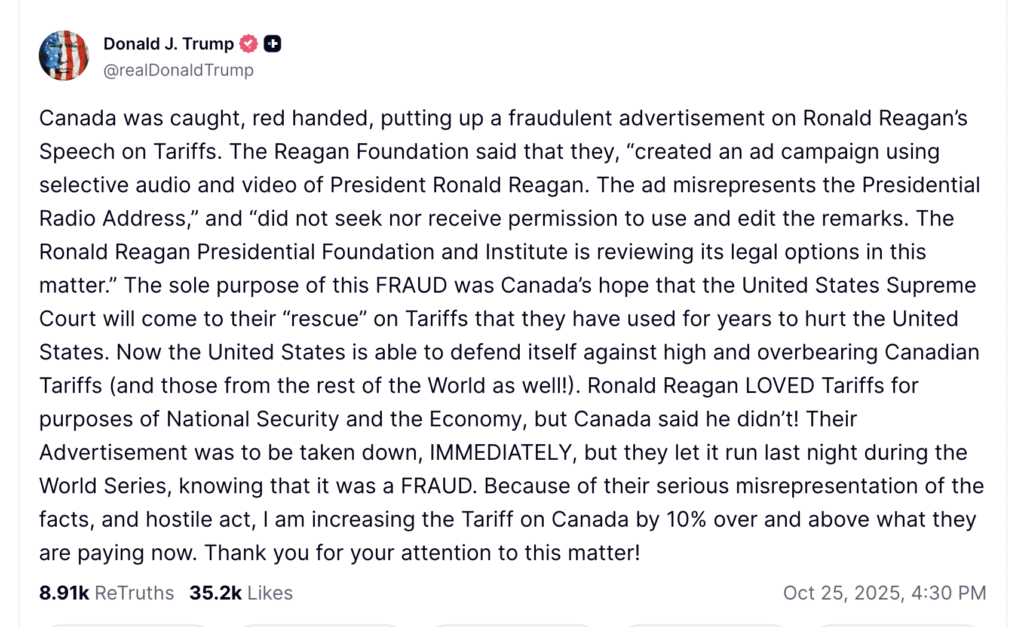
Now the ad was deliberately made for the worst possible hit on Mr. Trump (and editing is necessary; you don’t run commercials for 5 minutes!). Nevertheless, you can’t watch the full 5 minutes and fail to see that Mr. Reagan is wanting to make clear his strong preference for no tariffs and completely free trade, even though when a country is violating their agreements, he felt it might be a necessary step toward free trade.* You can never truthfully say that “Ronald Reagan LOVED Tariffs for purposes of National Security and the Economy”. Maybe a necessary evil as an occasional tool, but Mr. Reagan would strongly condemn Mr. Trump’s approach on trade were he alive today. Don’t take my word, or Mr. Trump’s; watch it for yourself.
Mr. Reagan made political compromises which weren’t always consistent with his free market goals, yet there was never any doubt that they were tactical concessions to the strategic goal of liberty in markets. Mr. Trump, you still have a few lessons to learn from the Gipper.
Edit Update: Should have checked out the WSJ this morning before posting; they say essentially the same thing (even stronger though) in their op-ed.
* If you have access to the WSJ op-ed, they remind me that Mr. Reagan was doing this to cut off a much stronger anti-Japan movement that Dick Gephardt was trying to push in the Congress. Mr. Gephardt and many of the populists of the time were staunchly anti-free trade. So the Gipper was taking a tactical step back for the strategic victory which he wanted.
 Bert Wheeler
 Jeff Haymond
 Marc Clauson
 Mark Caleb Smith
 Tom Mach